Electric vehicles are changing more than the way people travel. They are also changing what customers expect from businesses, hotels, retailers, and public destinations.
So, how can ev charging enhance customer experience? The answer begins with convenience. A driver who finds a clean, clearly marked charger can shop, dine, or work without unnecessary stress. A visible charging bay may turn a short visit into a longer stay. A reliable mobile payment system can make the process feel almost effortless.
Oliver Blume, CEO of Volkswagen Group, has said, “The future is electric.” His statement reflects a wider industry direction, but it does not solve every customer concern. Chargers must work. Prices must be easy to understand. Waiting areas should feel safe, comfortable, and useful.
Small details matter. A supermarket can place chargers near the entrance and offer digital updates when charging finishes. A hotel can provide overnight charging and explain connection procedures during check-in. A workplace can reserve spaces fairly and display real-time availability.
The experience is not perfect yet. Broken connectors, unclear tariffs, and slow customer support still frustrate drivers. These weaknesses deserve honest attention. More charging points alone will not create loyalty.
Businesses should measure charging success through practical evidence. They can track uptime, session completion, support requests, repeat visits, and customer feedback. They should also test the process with first-time users.
When charging feels predictable, customers gain confidence. When it feels confusing, even a modern facility can disappoint. EV charging is therefore not merely an energy service. It is a visible part of the customer journey.
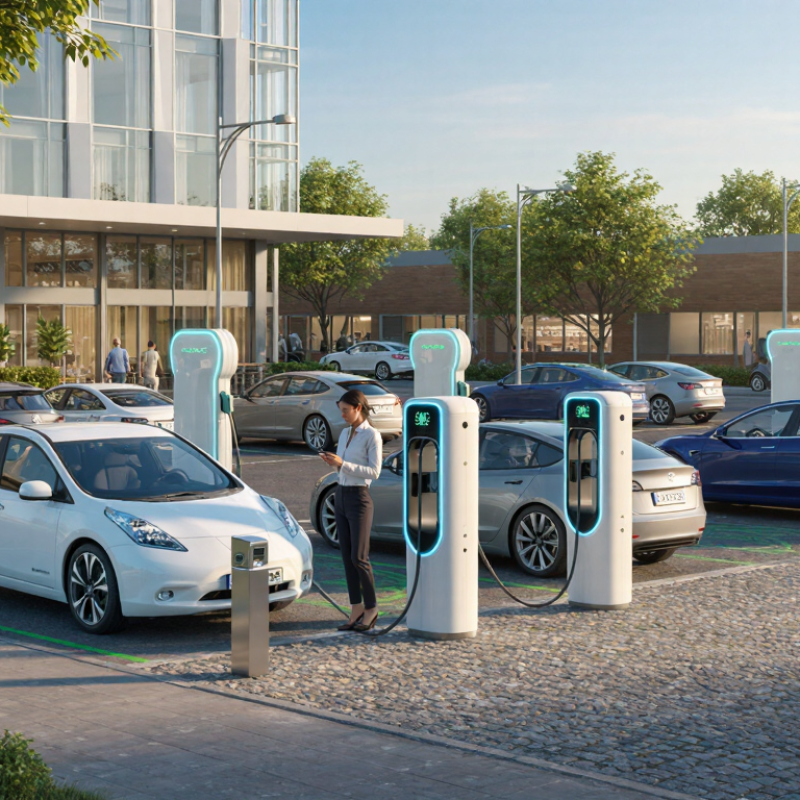
EV charging means supplying electricity to an electric vehicle through a controlled charging system. Its purpose is practical: restore driving range, manage energy demand, and support reliable daily travel. The IEA Global EV Outlook 2024 reported more than 14 million electric car sales in 2023. Electric cars represented about 18% of new-car sales worldwide. This growth makes charging part of the customer journey, not just a technical service.
A well-planned charger reduces uncertainty. Customers notice clear instructions, visible pricing, safe lighting, and simple payment steps. They also value accurate status updates when a charger is occupied or unavailable. In real site operations, small delays can damage trust quickly. A ten-minute wait may feel longer beside a silent, confusing machine.
Reliability still needs work. A charger that starts fast but stops unexpectedly creates frustration and extra support requests. That weakness should not be hidden.
Tips: Place chargers near entrances and essential facilities. Use readable screens and weather-resistant equipment. Display support contacts clearly. Track session failures, waiting time, and repeat visits. These details turn charging data into service improvements. The U.S. Department of Energy’s Alternative Fuels Data Center emphasizes connector availability and station status as important public charging information. Operators should review these indicators regularly. Not every customer wants the fastest charger; some want predictable charging during shopping, work, or overnight parking. The better question is not only “How fast?” but “How useful is this stop?”
EV charging begins with a controlled conversation between the vehicle, charger, and electrical supply. The connector carries power, but it also carries information. When a driver plugs in, the system checks the connection, confirms safety limits, and identifies the vehicle’s charging request. A compact control unit manages this exchange. It prevents energy flow when the plug is loose or damaged. Safety comes first. This quiet check often takes only seconds, yet it shapes the customer’s first impression.
Most public chargers use alternating current or direct current. With AC charging, the vehicle’s onboard charger converts grid electricity into battery power. With DC fast charging, conversion happens inside the charging equipment. Energy reaches the battery more directly. The vehicle’s battery management system still controls the process. It monitors temperature, voltage, and charging speed. As the battery fills, charging usually slows. This protects battery health and reduces electrical stress. A charger may appear powerful, but the vehicle decides how much power it can accept.
Behind the screen, software balances demand, records energy use, and supports payment authorization. Load management can reduce output when several vehicles charge together. That helps avoid unnecessary strain on a building’s electrical service. Clear status lights and accurate time estimates matter too. Customers should know whether charging has started, paused, or finished. No system is perfect. A weak signal can interrupt authorization unexpectedly. That detail deserves more attention. Better diagnostics, accessible cable placement, and simple instructions can make a technically sound system less frustrating.
Estimated time required to add 100 km of driving range at different charging power levels. The calculation assumes an average energy consumption of 18 kWh per 100 km; actual times vary with vehicle efficiency, battery state of charge, temperature, charging losses, and power tapering.
Customer experience insight: Higher-power charging can significantly reduce waiting time, making retail, hospitality, workplace, and highway charging more convenient for EV drivers.
What Is EV Charging? How Can It Enhance Customer Experience?
The main types of EV chargers serve different customer needs. Level 1 charging uses a standard household outlet and suits overnight parking. It is slow, but affordable and simple. Level 2 charging delivers higher power through dedicated equipment. It fits workplaces, apartments, hotels, and retail car parks. Drivers can shop or work while their vehicles gain useful range. The U.S. Department of Energy identifies Level 2 as a practical option for regular daily charging.
Speed matters.
DC fast chargers send direct current to the battery without relying on the vehicle’s onboard charger. They support highway stops, taxi operations, and urgent top-ups. However, charging speed varies with battery temperature, vehicle limits, and station power. A powerful connector cannot guarantee a short visit. That detail is often overlooked.
The International Energy Agency reported more than four million public charging points worldwide at the end of 2023. It also recorded public charging growth of about 40% that year. These figures show rising demand, but availability alone does not create a good experience. Clear signs, reliable payment, lighting, cable accessibility, and accurate status information matter equally. A 2024 industry survey by the Electric Vehicle Council found that charger reliability remains a major concern for drivers. Operators should monitor failed sessions and repair times, not only installation numbers. I may be too optimistic about technology solving every service problem. A charger beside a busy entrance can still frustrate customers when queues block access.
| Charger Type | Power Range | Current Type | Typical Charging Speed | Common Locations | Best Use | Customer Experience Benefits | Key Considerations |
|---|---|---|---|---|---|---|---|
| AC Level 1 | Approximately 1.4–1.9 kW | Alternating current (AC) | About 3–8 km of driving range per hour, depending on the vehicle | Homes, workplaces, and locations with long parking periods | Overnight charging and low-mileage daily travel | Low installation complexity and convenient charging wherever a suitable household outlet is available | The slowest option; a full charge can take more than 24 hours for some vehicles |
| AC Level 2 | Approximately 3.7–22 kW | Alternating current (AC) | About 16–80 km of driving range per hour, depending on power and vehicle limits | Homes, offices, hotels, retail centers, parking facilities, and public destinations | Daily charging during work, shopping, dining, or overnight stays | Balances charging speed, operating cost, and dwell time; supports repeat visits and longer customer stays | The vehicle's onboard AC charger may limit the actual charging rate |
| DC Fast Charging | Approximately 50–149 kW | Direct current (DC) | Roughly 160–480 km of driving range per hour under suitable conditions | Highways, travel corridors, service areas, convenience locations, and urban charging hubs | Rapid top-ups during road trips and time-sensitive travel | Reduces waiting time and increases location attractiveness for drivers who need a quick recharge | Charging speed decreases as the battery fills; battery temperature and state of charge affect performance |
| High-Power DC Charging | Approximately 150–350 kW or more, where supported | Direct current (DC) | Often up to approximately 480–1,120 km of driving range per hour under ideal conditions | Major highways, fleet depots, mobility hubs, and high-traffic commercial sites | Very short stops, long-distance travel, and high-utilization fleets | Provides the shortest potential stop times and helps improve perceived service speed | Requires substantial electrical capacity; the vehicle must support high-power charging to receive the full benefit |
| Destination Charging | Usually 3.7–22 kW | Alternating current (AC) | Typically adds approximately 16–80 km of driving range per hour | Hotels, restaurants, attractions, offices, apartment buildings, and shopping centers | Charging while customers spend 1–8 hours at a destination | Encourages longer visits, improves convenience, and can make a location more appealing to EV drivers | Value depends on parking duration, charger availability, pricing clarity, and reliable access |
| Fleet Charging | Approximately 7–350 kW, depending on vehicle type and schedule | AC or DC | Varies from several kilometers per hour to several hundred kilometers per hour | Logistics depots, corporate facilities, bus yards, taxi bases, and delivery hubs | Planned charging for commercial vehicles with predictable routes | Improves vehicle availability, supports route planning, and can reduce operational disruption | Load management, charging schedules, vehicle utilization, and electrical infrastructure are essential |
| Wireless Charging | Commonly up to approximately 11 kW for stationary systems | Alternating current transferred inductively | Comparable to moderate AC charging, depending on system design | Private parking spaces, taxi stands, bus stops, and controlled fleet facilities | Frequent short charging sessions without manual cable handling | Offers a highly convenient, cable-free experience and may improve accessibility for some users | Deployment costs, vehicle compatibility, alignment, and energy efficiency must be evaluated |
Electric vehicle charging can make a customer’s visit more useful and comfortable. A driver may need only twenty minutes, but that time shapes the entire experience. Clear signs, visible charging bays, and simple payment instructions reduce uncertainty. Customers can then shop, eat, or attend an appointment without repeatedly checking the charger.
Reliable equipment matters most. A charger that starts quickly builds trust, while a failed session can damage an otherwise excellent service visit. Businesses should check connectors, screens, cable condition, and lighting regularly. They should also display pricing, estimated charging times, and support contact details before customers begin. Small comforts help too. Seating, shade, clean restrooms, and nearby refreshments turn waiting into practical personal time. Accessibility must remain part of the design, not an afterthought.
Tips: Keep charging spaces clearly marked and free from unrelated parking. Test each connector during routine site inspections. Record common customer complaints, because they often reveal confusing signs or payment steps. Train staff to explain basic charging safely without making promises about exact charging speeds. In practice, not every session feels smooth. Weather, vehicle compatibility, and grid limits can affect results. Honest information is better than perfect-sounding claims. A short message explaining a delay may protect trust more effectively than silence. Customer feedback should also influence layout changes, especially when drivers struggle with cable reach, lighting, or finding the exit.
EV charging is more than a socket beside a parking space. It can shape how customers use a business. A reliable charger gives drivers time to shop, eat, work, or rest. The experience depends on clear signs, simple payment, lighting, and a safe walking route. Small details matter.
Different locations need different charging plans. A retail center may benefit from several medium-speed chargers near store entrances. Customers often stay for one or two hours. A hotel may need overnight charging, with cables placed away from pedestrian paths. Offices can use scheduled access and longer charging periods. Restaurants should consider faster options, because diners may stay for less time. Rural sites need visible chargers, weather protection, and dependable network coverage.
Plan around real demand, not assumptions. Review parking duration, electrical capacity, local permits, and peak traffic. Leave space for future expansion. An on-site electrical assessment can prevent costly upgrades later. Chargers should support accessibility and avoid blocking essential parking routes. Maintenance response also affects trust. A broken unit with no status message creates frustration quickly.
No plan is perfect. Early usage may be lower than expected. That is useful evidence, not failure. Monitor sessions, waiting times, energy use, and customer feedback. Adjust pricing, signage, or charger numbers when the data supports it. The best charging area feels easy to understand, even for a driver using it for the first time.
The connector carries electricity and safety information. The vehicle and charger check their connection first. Charging stops if the plug is loose or damaged. This usually takes only seconds.
AC charging uses the vehicle’s onboard charger to convert electricity. DC charging converts electricity inside the charging equipment. It can send energy to the battery more directly. Actual speed still depends on the vehicle.
The vehicle’s battery management system controls how much power it accepts. It monitors temperature, voltage, and charging speed. Charging often slows as the battery fills. A powerful charger cannot force higher power into the vehicle.
Battery temperature, vehicle limits, and electrical demand can reduce charging speed. Several vehicles may also share available power. The screen should explain delays clearly. Estimates are useful, but they are not promises.
Software manages demand, records energy use, and handles payment authorization. Load management can lower output during busy periods. This helps protect a building’s electrical service. Weak signals may still interrupt authorization.
Customers should see pricing, estimated charging time, and support contact details. Clear lights should show whether charging started, paused, or finished. Simple instructions reduce uncertainty. Confusing screens remain a common weakness.
Clear signs, visible bays, and reachable cables make the process easier. Seating, shade, clean restrooms, and nearby refreshments make waiting more practical. Good lighting helps customers feel safer. Small details matter.
Staff should inspect connectors, screens, cables, and lighting regularly. Each connector needs routine testing. Charging spaces should stay free from unrelated parking. Customer complaints can reveal problems that inspections miss. Mistakes happen. Teams should learn from them.
EV charging is the process of supplying electricity to electric vehicles through specially designed charging equipment. By connecting the vehicle to a power source, the system safely transfers energy to the battery, with charging speed depending on the charger type, vehicle capacity, and available power. Slow chargers are suitable for long stays, while faster options serve drivers who need a quick top-up during shorter visits. Selecting the right system depends on location, parking time, traffic levels, and customer needs.
Businesses can use EV charging to create a more convenient and welcoming experience. Drivers may spend more time shopping, dining, working, or using onsite services while their vehicles charge, reducing waiting-related frustration and adding practical value to their visit. Clear instructions, reliable equipment, accessible parking spaces, and transparent pricing can further improve satisfaction. To plan effectively, businesses should consider electrical capacity, expected demand, space layout, maintenance, and future growth. Overall, how can ev charging enhance customer experience is answered through convenience, comfort, and better use of customers’ time.

Orange Energy