Electric vehicles (EVs) are transforming transportation. As more people adopt EVs, charging infrastructure becomes essential. A key question arises: what is the difference between public and commercial EV charging?
Public charging stations are accessible to everyone. They are often found in public places like parking lots and shopping centers. These stations help EV owners charge their vehicles while they run errands or enjoy leisure activities. Convenience is a significant benefit, but the charging speed can vary.
On the other hand, commercial charging stations cater to businesses. They are often installed at fleet depots, hotels, and workplaces. Commercial charging is designed for specific use and offers faster charging options. However, limited access may be a downside for individual users. Recognizing these differences can help EV owners choose the right charging option for their needs.
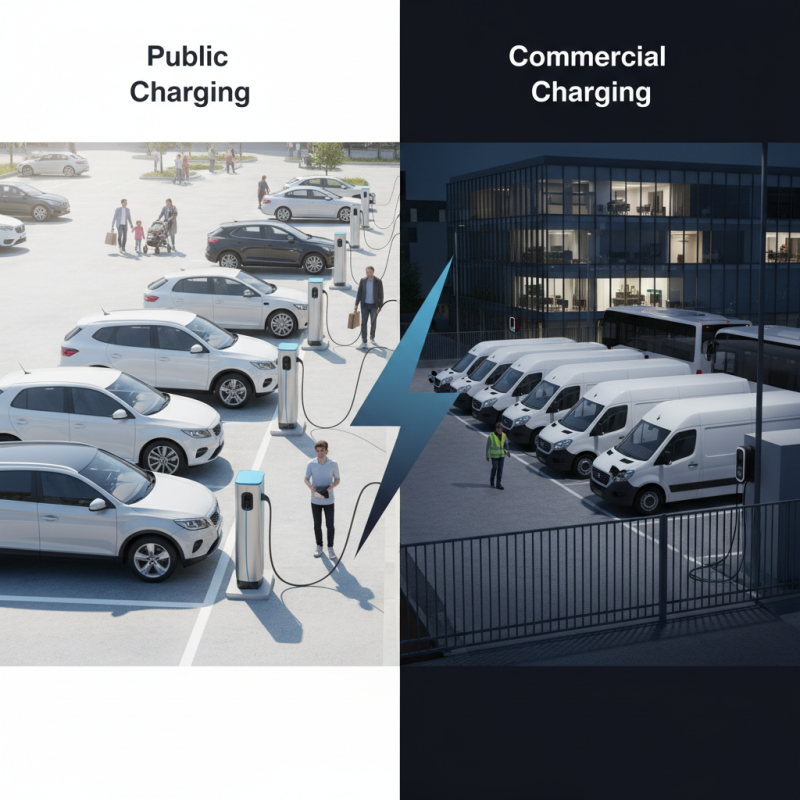
Public EV charging refers to the infrastructure available for electric vehicles (EVs) that is accessible to all users. This includes charging stations set up in various locations like parking lots, public garages, and along highways. Data from the International Energy Agency indicates that there were over 1.8 million public charging points globally by the end of 2022. This growth is critical for supporting the increasing number of EVs on the road.
Public charging points come with unique characteristics. They often offer different charging speeds, ranging from slow Level 2 chargers to fast DC fast chargers. According to the U.S. Department of Energy, about 80% of public charging stations are Level 2, providing a balance between accessibility and charging speed. However, the distribution of these chargers is uneven. Urban areas tend to have more charging stations than rural ones, creating gaps in accessibility for some users.
Moreover, the reliability of public chargers can vary. Some users report frequent malfunctions or incompatibility issues. This inconsistency can lead to frustration and inconvenience. Maintenance is essential, yet some charging networks do not prioritize it effectively. This reflects a need for improvement in management and user experience in public EV charging infrastructure.
The chart above shows the comparison between the number of public and commercial electric vehicle (EV) charging stations. Public charging stations are generally available for all EV users, while commercial charging stations are often located at businesses and may require a subscription or payment for use, highlighting the growth of infrastructure in both sectors.
Commercial EV charging stations serve a crucial role in the electric vehicle landscape. These stations are designed for businesses, municipalities, and other organizations that aim to support electric vehicle adoption. According to a recent industry report, the global commercial EV charging market is expected to expand by over 25% annually, reflecting a surge in demand.
Key features of commercial charging stations include fast charging capabilities. These stations often provide higher power outputs compared to public stations. The average charging time can drop significantly to just 30 minutes for an 80% charge. This is essential for keeping fleet vehicles and taxis operating efficiently. Furthermore, commercial charging stations can support multiple vehicles simultaneously, optimizing the use of space and resources.
Tips: Consider the location of a commercial charging station carefully. High-traffic areas will naturally attract more users. Ensure that the pricing structure is transparent and competitive to draw in customers. Reflect on the need for regular maintenance. A well-maintained charging station performs better and builds user trust. The experience should be convenient and user-friendly, making EV adoption more appealing.
In recent years, the growth of electric vehicle (EV) charging infrastructure has become crucial. Two primary types stand out: public and commercial charging stations. Public chargers are typically located in accessible areas. They can be found at shopping centers, parks, and along highways. These stations often cater to a broad audience, including casual users and long-distance travelers. However, their availability can be inconsistent, leading to potential challenges for EV owners.
On the other hand, commercial charging stations are usually found at businesses and workplaces. Businesses may install them to serve their customers or employees. This setup creates a more predictable charging environment. Commercial chargers often provide faster charging options as well. Nevertheless, this network might be limited to specific hours, leading to accessibility issues. Some locations may have long wait times during peak hours.
Both infrastructure types have strengths and weaknesses. Public charging stations improve accessibility but might lack reliability. Commercial stations offer convenience but may restrict access. Balancing these systems is essential for a sustainable EV future. Evaluating the gaps helps communities improve their charging infrastructure.
Public and commercial EV charging options have unique benefits and drawbacks. Public charging stations are usually found in accessible areas, such as parking lots and shopping centers. They offer convenience for those needing a quick charge while on the go. However, the availability of these stations can be inconsistent. Long wait times may occur during peak hours, leading to frustration.
On the other hand, commercial charging setups often cater to businesses and fleets. They provide dedicated charging solutions tailored to the needs of companies. This can lead to better management of charging times and costs. However, commercial stations may not be open to the public, limiting their accessibility. Businesses might face high installation costs, which can be a barrier to entry.
Both options are essential for the growth of electric vehicles. Each has its own limitations that require consideration. While public chargers offer more convenience, they can lead to overuse and congestion. Commercial stations provide more control, yet they may not be easily reachable for everyday drivers. Finding the right balance between them will be crucial as demand for EV infrastructure continues to grow.
The landscape of public and commercial EV charging is evolving rapidly. Innovations in technology are redefining how these solutions operate. Charging stations are becoming smarter, offering faster connection times and improved user interfaces. Many municipalities are investing in public infrastructure to make charging more accessible. Still, the disparity in availability remains a concern.
Commercial operators face unique challenges. They need to balance installation costs with potential revenue. Some locations may experience high demand, while others struggle to attract users. It’s essential for these operators to analyze usage patterns. This can help optimize placement and service frequency. Integrating renewable energy sources into charging systems can also enhance sustainability efforts. However, not all commercial setups currently embrace this approach.
Looking ahead, user experience will guide development. Simplicity in payment methods and real-time data access are crucial. However, as more users switch to electric vehicles, how to handle demand surges poses a question. The industry must adapt or risk frustrating new adopters. Balancing both public and commercial needs will define the future of EV charging. While there’s potential, careful planning is necessary to meet growing expectations.
: Public EV charging refers to charging stations accessible to all users, found in various locations.
They can be found in parking lots, public garages, and along highways.
There were over 1.8 million public charging points worldwide by the end of 2022.
Public stations provide slow Level 2 chargers and fast DC fast chargers.
Users report frequent malfunctions and compatibility issues with public charging stations.
Urban areas have more stations, while rural areas often have gaps in accessibility.
Public chargers are available in accessible locations, while commercial chargers are often at business sites.
They may offer faster charging, but access can be limited to specific hours.
Long wait times may occur during peak hours, affecting accessibility for users.
Evaluating and improving the balance between public and commercial charging systems is vital.
The article titled "Difference Between Public and Commercial EV Charging Explained" explores the distinct characteristics and purposes of public and commercial electric vehicle (EV) charging infrastructures. Public EV charging refers to accessible stations located in various places, enabling general consumers to charge their vehicles conveniently. In contrast, commercial EV charging is typically designed for businesses and services, catering to fleet vehicles or commercial users with specific charging needs.
In a comparative analysis of the two types, the article highlights their respective benefits and drawbacks, such as availability, cost, speed of charging, and user experience. The discussion also addresses future trends in public and commercial EV charging solutions, emphasizing the ongoing evolution in infrastructure and technology. Ultimately, this leads to a clearer understanding of what is the difference between public and commercial EV charging, guiding users in choosing the most suitable option for their needs.

Orange Energy